

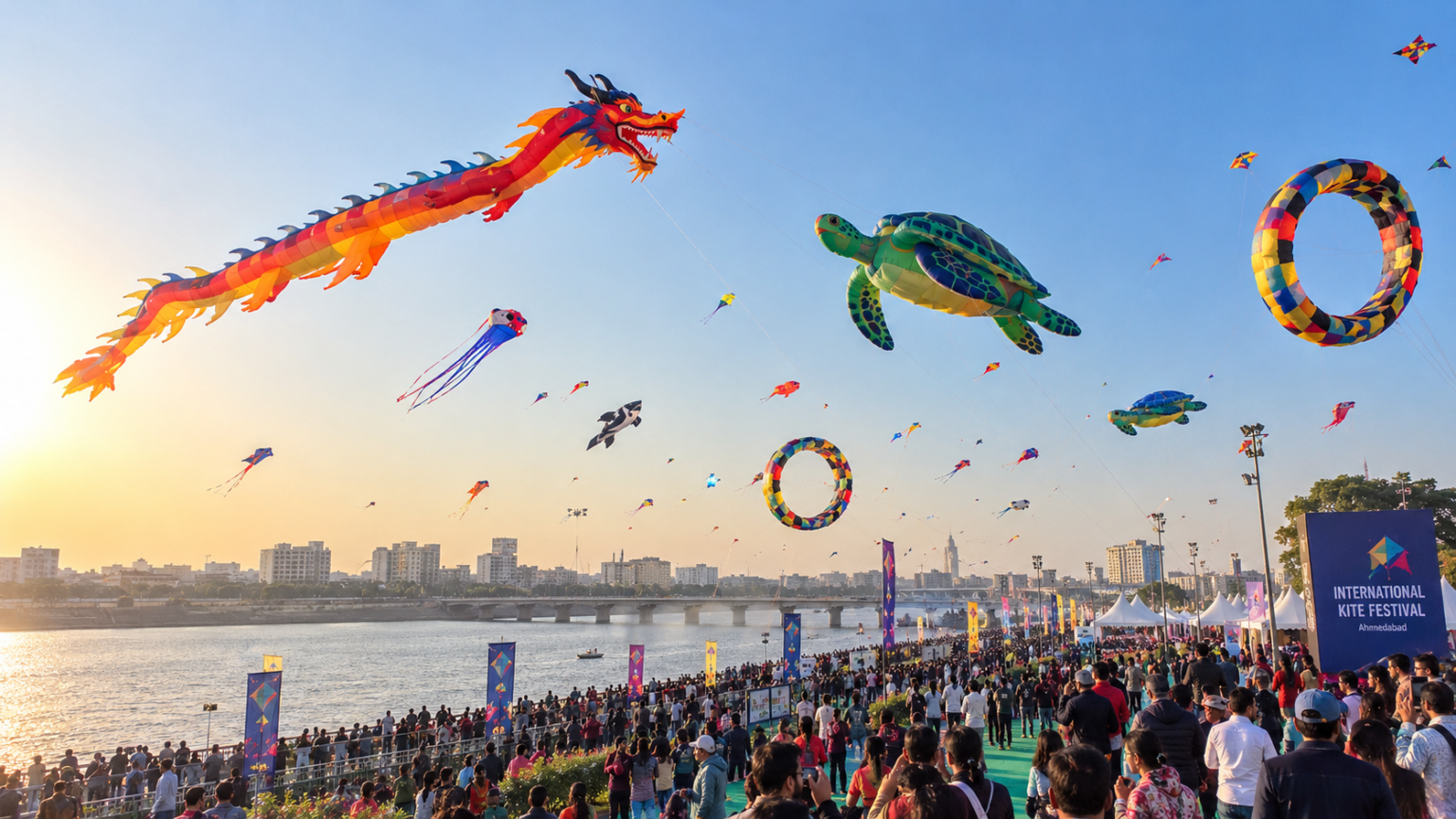
The International Kite Festival in Gujarat is a great winter feast. Millions of paper kites fill the clear skies over Ahmedabad each January. Travelers visit to watch top flyer teams. They also join rooftop duels across the old town.
This International Kite Festival guide gives verified dates, show times, and safety rules. Specifically, most guests need three to four days. This window lets you enjoy the main events well.
The state show runs along the river lawns. It takes place from January 8 to January 14, 2027. Then, citywide rooftop Uttarayan battles peak on January 14 and January 15.
Winter brings dry, bright days with warm sun. It also offers cool night air. Sardar Vallabhbhai Patel Airport and Kalupur Train Station give fast routes into town.
Top Festival Events in International Kite Festival
Sabarmati Riverfront Showcase in This International Kite Festival Guide
The official festival grounds sit on green lawns. They stretch along the Sabarmati Riverfront. Indeed, this International Kite Festival guide rates the riverfront as the top spot for giant show kites. Master kite makers come from forty nations. They fly massive show kites above the river water.
Crowds watch giant flying dragons, sea turtles, spinning rings, and bright banners. Furthermore, flyer teams show stunt kites dancing in tight pairs. Daytime winds pick up after 11:00 AM. Then, strong breezes lift huge nylon kites high into the sky.
The riverfront park has craft stalls, food stands, and shaded seats. In addition, entry to the public viewing lawns is free for all guests. Gates open daily at 10:00 AM. Peak flying runs until 5:00 PM.
Inside the world tents, makers show hand-painted washi paper kites from Japan. Also, teams from Malaysia fly giant moon kites called wau bulan. These big art kites float high above the river. Indeed, they draw cheers from big crowds.

Makar Sankranti Traditions: Sun Worship, River Ghats, and Sacred Charity
Uttarayan marks the solar shift of Makar Sankranti as winter ends. According to Hindu faith, the sun moves north. This happens on this holy day. This solar shift brings longer days and warmth. It marks the start of the spring harvest.
Devout families gather at dawn along the water. They pray to the sun god Surya along river steps. Furthermore, locals practice sacred charity by feeding fresh green grass to city cows.
Flying kites into the sun marks rising souls. Also, it sends prayers up to heaven.
Rooftop Uttarayan Battles in International Kite Festival
While the river lawns host show kites, the true heart beats across the Old City. On January 14 and 15, the entire town climbs to flat brick roofs. Families launch paper kites into the air. Thousands of swift fighters fill the bright sky.
Kite duels mean crossing cotton lines to cut rival strings in mid-air. When a flyer cuts a rival line, cheers ring out. Loud shouts echo across the flat roofs.
Cries of Kai Po Che fill the air. In fact, this Gujarati cry means I have cut it. Moreover, joyful shouts celebrate each victory in good fun.
Loud music plays from sound boxes. Meanwhile, neighbors share hot tea across walls. Moreover, visitors staying in old pols can join family roofs. For example, guests in Dhal ni Pol get warm invites. Local residents welcome polite travelers to hold string reels and try daytime flying.
Rooftop host families share plates of hot winter sweets with visiting guests. Also, children dash through narrow brick lanes below to catch loose falling kites. In fact, catching a cut kite brings good luck and great pride to young runners.

Jamalpur Kite Workshops in International Kite Festival
Months before the feast, artisan families get to work. They craft millions of fighting kites in Jamalpur. These skilled makers split thin bamboo by hand. They form light, balanced frames. They paste thin paper across the bent bamboo struts using natural glue.
Each kite design carries a local name. For example, flyers love the eagle cheel and triangular dhar. Furthermore, flyers take great care when tying the bridle string that balances flight. Shoppers pair kites with polished wooden reels called latais. In addition, skilled turners carve these spools from solid wood.
Artisans work long days in small home shops. They stack colorful paper sheets in tall piles. Skilled makers test each bamboo strut for flex.
They split the cane with small hand knives. Then, they test the kite balance in calm air. Indeed, buying kites direct from Jamalpur makers saves money and supports local craft.
Kite Fighting Tactics: The Art of Dheel and Kheech in Sky Combat
Winning a rooftop kite duel needs quick hands. It also takes good wind sense. Flyers use two main battle tactics. These are known across Gujarat as dheel and kheech. In the dheel method, flyers feed out line fast. The wind drags thread through rival lines.
In contrast, the kheech tactic uses a swift pull. This sharp tug slices the rival string. Master flyers watch the dip of the kite line. Then, they feel the line tension before striking. As a result, sky duels become fun games of skill and friendly rivalry.
Midnight Patang Bazaar: All-Night Kite Markets and Festive Crowds
During festival week, Patang Bazaar near Delhi Gate stays open all night long. This narrow street market fills with bright paper. In addition, wooden spools and happy buyers crowd the lane. Shoppers browse tall stacks of paper kites made by skilled craftsmen in Jamalpur.
Kite sizes range from tiny palm-sized fighters to giant decorative wall kites. In addition, shoppers buy polished wooden reels called latais. Workers wind these spools with tough battle line.
Visit between 10:00 PM and 2:00 AM. This window lets you feel the midnight market rush. Bargaining is normal when buying kites. Shoppers buy bundles of fifty or one hundred.
Food carts line the street outside the market. They serve hot tea and spicy snacks to night buyers. Meanwhile, music plays from stalls as sellers shout out daily deals.
Night Tukkal Lanterns: Floating Candle Balloons and Sky Illuminations
The festival changes character as sunset darkness falls across the old town. Instead of paper kites, flyers tie box lanterns called tukkals to kite lines. Tiny burning candles or LED lights sit inside the tukkals. Soon, they float high into the evening breeze.
Soon, hundreds of glowing lanterns drift like floating stars above the dark roofs. Meanwhile, rooftop fireworks and sparklers burst into colorful lights over the river. Flyers light each cotton wick with care.
Soon, warm air lifts the paper box up high. Loud music plays as the night sky glows. This night light show lasts until midnight. As a result, it closes the festival day with warm joy.
Traditional Manja Making: Rice Paste, Mineral Colors, and Cotton Cord
Traditional cotton line requires careful work. Artisan street dyers make it by hand. Workers stretch long cotton cords between wooden posts. They string the line along open sidewalks. They coat the line with cooked rice glue. In addition, they mix in egg whites and natural mineral powder.
This craft yields a strong battle thread. Also, it cuts clean without wire hazards. Furthermore, master flyers select specific thread thicknesses based on daily wind speed. A lighter cord suits gentle morning air. In contrast, heavier line resists strong afternoon gusts.
UNESCO Old City Heritage
Travelers following this International Kite Festival guide should also explore the Old City’s UNESCO heritage. Ahmedabad was India’s first UNESCO World Heritage City. Sultan Ahmed Shah founded the town in 1411. The historic center holds six hundred pols. These are gated neighborhood quarters.
Walk narrow lanes to admire wooden town homes. Also, look for carved brackets and peacock pillars. In addition, look for chabutras. These tall carved towers provide food for wild birds.
A short drive north brings you to Adalaj Stepwell. Builders carved this deep five-story well in 1498. This stone water well features carved galleries. It has cool stone floors and floral pillars.
Queen Rudabai built this grand stone well over five centuries ago. It gave weary desert traders a cool resting spot. There, they could pause and drink clean water. Today, travelers admire its stone pillars and quiet underground shade.
Historic Heritage Sites: Sarkhej Roza and Sidi Saiyyed Mosque
Beyond the kite roofs, Ahmedabad holds great medieval Islamic architecture. Visit Sarkhej Roza near the town edge. In addition, this tomb and palace complex surrounds a quiet water tank. Architect Le Corbusier praised its pure lines. He loved its peaceful stone courtyards.
In addition, visit the famous Sidi Saiyyed Mosque near the city center. This sixteenth-century mosque is world famous. It features stone tree of life carved windows. These delicate stone screens look stunning. They show the high peak of local stone craft.
Patang Kite Museum: Historic Collections at Sanskar Kendra
For deeper context, visit the Patang Kite Museum. Indeed, it sits inside the Sanskar Kendra cultural center. Architect Le Corbusier designed this red brick building. He completed the work in 1954. Inside, the gallery displays rare historic kites. It also shows miniature paintings and antique wooden reels.
Visitors can examine kites made from hand-painted silk. In addition, exhibits show gold foil and Japanese paper kites. Furthermore, displays explain centuries of kite warfare. They also highlight royal Indian court games. Entry into the museum is free. Therefore, it makes an easy cultural stop near the river.
Wildlife Protection Rules: Glass Manja Bans and Bird Rescue Camps
String safety laws are vital for guests. This International Kite Festival guide details all local rules. City police strictly ban synthetic nylon line and sharp glass-coated thread across Gujarat. This sharp line harms wild birds, cuts power lines, and hurts motorcycle riders. Therefore, responsible travelers must fly kites only with pure cotton thread.
The state runs the Karuna Abhiyan bird rescue drive. Meanwhile, vets set up animal care camps across town. Spot a trapped bird or loose line? Call local rescue teams right away for quick help. Also, watch your footing on old rooftops that lack protective edge walls.
Traditional Winter Feasts: Undhiyu, Jalebi, and Sesame Chikki
No Uttarayan feast is complete without tasting classic seasonal Gujarati food. Families cook big pots of Undhiyu. This rich stew mixes winter beans, roots, and herb balls. Locals pair this savory stew with hot sweet jalebis. Cooks fry these sweets fresh from boiling sugar pans.
Throughout the day, flyers snack on crunchy sesame chikki. They also eat roasted nuts on the roof. Sip cups of sweet ginger milk tea on the roof. Watch sky duels unfold across the open city. You can pair your Gujarat cultural trip with the Rann Utsav festival in Kutch.
Getting to Ahmedabad: Airport Connections and the Metro Line
Reaching Ahmedabad is simple thanks to modern air, rail, and metro links. Sardar Vallabhbhai Patel Airport connects smoothly to international hubs and local cities. From Kalupur Railway Station, auto rickshaws reach the Old City within fifteen minutes.
The Ahmedabad Metro line links east and west quarters across the Sabarmati River. Take the metro to Old High Court stop. From there, enjoy a quick ten-minute walk to the river grounds. Pair this trip with our Jaipur Pink City travel guide. Also, explore our sacred Varanasi travel guide.
Where to Stay in Ahmedabad
Picking the right base saves travel time. You can reach both river lawns and historic pols with ease. Our International Kite Festival guide suggests staying near the Old City. This location offers direct rooftop access.
For historic stays, book The House of MG. It is a restored mansion in the Old City. This heritage base features quiet courts, textile shops, and authentic Gujarati thali dining.
For modern comfort by the water, choose Hyatt Regency Ahmedabad along Ashram Road. This riverfront hotel provides spacious rooms. In addition, you get views of kites soaring over the water. Budget backpackers will find clean, cheap inns around Relief Road near the station.
International Kite Festival Travel Costs and Daily Budget Guide
Traveling in Gujarat offers great value for independent cultural guests. This International Kite Festival guide shows high value. Visitors can enjoy festival days on low funds. Below is a clear view of typical daily costs across three travel styles.
| Expense Category | Budget Traveler (INR / USD) | Mid-Range Traveler (INR / USD) | Luxury Traveler (INR / USD) |
|---|---|---|---|
| Accommodation | ₹800–1,500 ($10–18) / night (Relief Road guest house) | ₹3,500–6,000 ($42–72) / night (Heritage haveli in pol) | ₹12,000–22,000 ($145–265) / night (5-star riverfront base) |
| Daily Meals & Street Food | ₹400–700 ($5–8) (Undhiyu, jalebi, thali) | ₹1,200–2,000 ($14–24) (Heritage court restaurants) | ₹3,500–6,500 ($42–78) (Fine dining hotel venues) |
| Local Transportation | ₹150–300 ($2–4) (Ahmedabad Metro & shared auto) | ₹600–1,200 ($7–14) (Private auto-rickshaw hire) | ₹2,500–4,500 ($30–54) (Chauffeur-driven AC car) |
| Kites, Spools & Supplies | ₹300–600 ($4–7) (20 fighter kites & cotton latai) | ₹1,000–2,000 ($12–24) (50 premium kites, reels, tukkals) | ₹3,500–7,000 ($42–84) (Master collector kites & lanterns) |
| Estimated Daily Total | ₹1,650–3,100 ($20–37) | ₹6,300–11,200 ($76–135) | ₹21,500–40,000 ($259–482) |
Prices were checked on 08 October 2026. Currency conversions use 83 INR per USD.
Recommended 3-Day International Kite Festival Guide Itinerary
This three-day plan balances riverfront show viewing with authentic Old City rooftop battles. Follow this International Kite Festival guide route. You will experience both global kite masters and local traditions.
| Day | Timing Window | Primary Focus | Activity Highlights & Cultural Sights |
|---|---|---|---|
| Day 1 | Morning (10:00 AM – 1:00 PM) | Sabarmati Riverfront | Watch international master flyers launch giant inflatable dragons and stunt kites from public riverfront lawns. |
| Day 1 | Afternoon & Evening | Sanskar Kendra & Markets | Tour the Patang Kite Museum, browse Jamalpur kite artisan workshops, and explore Delhi Gate markets. |
| Day 2 | All Day (Makar Sankranti) | Old City Pol Rooftops | Join local families on Dhal ni Pol terraces for rooftop kite battles, shouts of Kai Po Che, and hot Undhiyu feasts. |
| Day 2 | Night (7:00 PM – Midnight) | Sky Illuminations | Release glowing tukkal box lanterns from rooftops and experience the midnight energy of Patang Bazaar. |
| Day 3 | Morning & Afternoon | UNESCO Heritage Sights | Explore the 5-story carved Adalaj Stepwell, the serene Sarkhej Roza tombs, and the delicate Sidi Saiyyed Mosque screens. |
Frequently Asked Questions About the International Kite Festival Guide
When does the International Kite Festival take place in 2027?
The official Sabarmati Riverfront showcase runs from January 8 to January 14, 2027. Citywide rooftop kite flying peaks on Makar Sankranti on January 14 and January 15.
Do visitors need tickets to enter the Sabarmati Riverfront festival?
No, entry to the official riverfront grounds is free. Visitors can walk into the viewing zones without advance booking, though arriving early secures better riverside seating.
How can foreign travelers join rooftop kite flying in the Old City?
Staying at an Old City heritage hotel or booking a local guided heritage walk often includes rooftop access. Many local families warmly invite polite visitors to join their terrace celebrations.
What traditional foods should I eat during the kite festival?
You must try clay pot Undhiyu curry paired with hot sweet jalebi. Roasted corn, sesame chikki peanut brittles, and fresh sugar cane juice are also popular rooftop treats.
Safety Essentials, Rooftop Precautions, and Responsible Travel
Always wear dark sunglasses and sunscreen. These protect your eyes and skin during long rooftop hours. Never step backward near roof edges. In addition, watch for loose kite strings when walking city streets.
Consult official schedules on Gujarat Tourism and general travel alerts on Incredible India. Civic updates from the Ahmedabad Municipal Corporation help with traffic. They also list open river gates.
Fly with care and celebrate community warmth. Together, we can help preserve the living sky traditions of Gujarat.


