

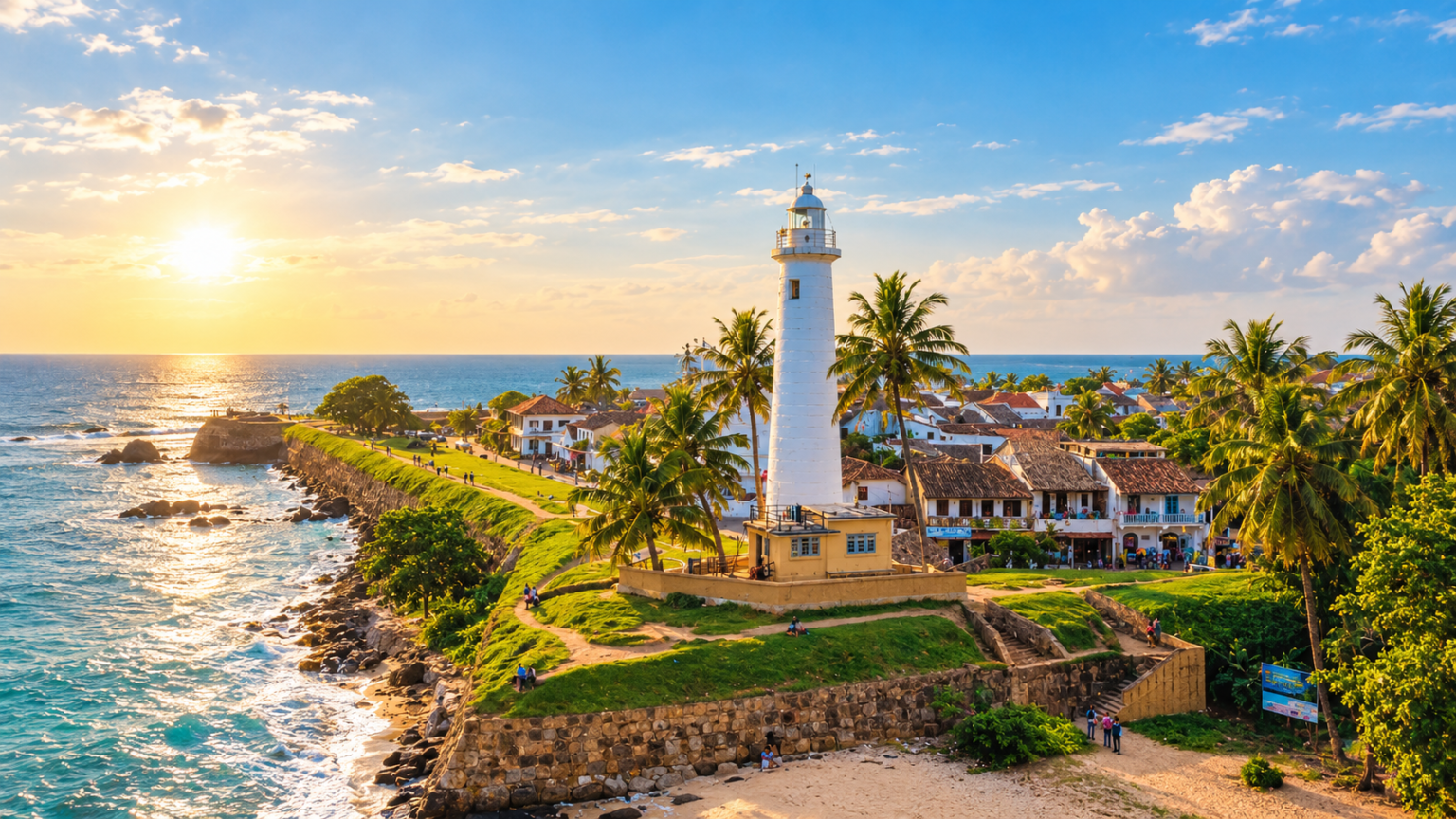
Ocean waves break against thick coral-stone ramparts. Warm sea winds sweep across Galle Bay. Above the stone wall, green coconut palms frame a tall white lighthouse.
Planning your trip takes clear facts on coastal trains. It also takes clear facts on free fort access and local prices. This Galle Fort travel guide gives practical advice for your journey.
Quick Facts for Galle Fort Visitors
- Location: Galle Bay, Southern Province, 119 kilometers south of Colombo.
- Main Sights: Flag Rock, Galle Lighthouse, Dutch Reformed Church, and Old Dutch Hospital.
- Fort Entry Fee: Free entry across all streets and sea ramparts.
- Train from Colombo: Coastal trains take two hours for 460 LKR ($1.40 USD).
- Best Season: December to April for sunny days and calm seas.
Getting to Galle Fort: Coastal Trains, Highway Buses & Taxis
Travel from the capital to the south coast is fast, cheap, and scenic. Most guests start from the busy center in our Colombo city guide.
Riding the train is the top route in this Galle Fort travel guide. Trains run by Sri Lanka Railways depart Colombo Fort station ten times daily. Third-class tickets cost 460 LKR ($1.40 USD). In addition, second-class seats cost 950 LKR ($2.90 USD).
When riding south from Colombo, sit on the right side. The railway tracks run right beside the sandy beach. Furthermore, express highway buses run from Makumbura station for 900 LKR ($2.70 USD).

Best Season & Weather for a Galle Fort Trip
Picking the right month brings dry walking days and calm sea winds. Read our Sri Lanka travel overview and highlights for seasonal tips.
The south coast enjoys sunny dry weather from December to April. During these months, daytime heat reaches 29°C (84°F). Cool ocean breezes keep walking pleasant. In contrast, the southwest monsoon brings rain from May to September.
The Historic Sea Ramparts and Stone Bastions
Walking the massive sea ramparts offers the finest experience in Galle Fort. Dutch engineers built these thick stone walls in the 17th century. They used ocean coral and heavy granite blocks.
Today, guests can walk the entire 2.5-kilometer stone circuit free of charge. This Galle Fort travel guide details each historic bastion along the route.
Point Utrecht Bastion and the Galle Lighthouse
Point Utrecht Bastion anchors the eastern tip of the southern sea wall. Here, the famous Galle Lighthouse rises 26 meters above green lawns. Built in 1939 to replace an older wooden tower, the white stone column stands tall. It looks out over crashing waves.
Below the bastion lies Lighthouse Beach. This small sandy cove stays calm behind shallow coral reefs. Local families gather here in the late afternoon. They dip their feet in calm shallows under swaying palm trees.
Guests can often spot wild green sea turtles here. They swim in the clear water near the reef edge.
Flag Rock Bastion: Sunset Views and Cliff Divers
Walking west along the sea wall leads to Flag Rock Bastion. During Dutch rule, soldiers watched from this rocky point. They used colored flags to signal passing merchant ships.
Today, Flag Rock forms the top sunset gathering spot in the entire fort. In the late afternoon, daring local athletes dive off high stone walls. They leap straight into crashing surf. They time their leap with incoming waves, drawing cheers from watching crowds.
A modest tip of 200 LKR to 500 LKR ($0.60 to $1.50 USD) gives fair support for photos.
Triton and Neptune Bastions: Ocean Panoramas
Continuing along the western rampart wall brings you to Triton Bastion and Neptune Bastion. These broad stone gun platforms offered clear views against enemy fleets.
Old iron cannons still rest inside stone gun ports. They point toward the open Indian Ocean. Soft sea breezes cool the wide grassy path. Golden sunbeams glitter across the open water.
Clippenberg Bastion and Western Sunset Bluffs
Just north of Triton Bastion sits Clippenberg Bastion. A small lighthouse once stood on this rocky corner during early British rule.
Crashing ocean swells send white sea spray high into the tropical air. In addition, wooden park benches line the path. Guests can sit peacefully and watch the sunset glow.
The Landward Defenses: Star, Moon, and Sun Bastions
On the northern landward side, three massive bastions protect the narrow peninsula. The Dutch named these the Star, Moon, and Sun Bastions. They built them to guard against inland attacks.
A deep seawater moat once separated these heavy walls from the mainland. Today, guests can walk atop the high earthen ramparts. The high wall offers sweeping views across Galle International Cricket Stadium.
Zwart Bastion: The Old Black Bastion
At the eastern corner stands Zwart Bastion, also called the Black Bastion. Historians consider it the oldest surviving stone fort in Galle. Portuguese sailors built its stone base in 1505 before Dutch expansion.
Nearby, Akersloot Bastion guarded the inner harbor entrance. Old trees shade the stone cannon platforms. It makes a peaceful spot to watch fishing boats enter the bay.
Aurora Bastion and the Inner Harbor Wall
Aurora Bastion faces east toward the protected bay. Dutch soldiers placed heavy bronze guns here. The guns defended supply ships from naval attack.
Early risers gather on this grassy corner at dawn. They watch golden sunbeams rise over distant headlands. Cool morning air makes this early stroll especially refreshing.
The Old Powder Magazine and Ammunition Vaults
Near Akersloot Bastion stands the Dutch powder magazine. Thick masonry vaults once stored black gunpowder and iron cannonballs away from enemy fire.
In past sieges, soldiers rolled heavy kegs through stone arches to supply the rampart gunners. Today, guests can walk past these fortified brick vaults and imagine life inside an 18th-century naval fort.
Historic Colonial Churches and Sacred Monuments
Inside the stone walls, Galle Fort preserves grand colonial buildings. It also holds sacred historic shrines. Exploring these sites reveals how Dutch, British, and local cultures merged over centuries.
Compare these sights with other iconic places to visit in Sri Lanka. Joining a licensed Galle Fort walking tour on GetYourGuide brings their stories to life.
Dutch Reformed Church: Groote Kerk
The Dutch Reformed Church, known as Groote Kerk, stands proudly on Church Street. Built in 1755, it ranks as one of the oldest active Protestant churches in Sri Lanka.
Its white gabled facade features simple classical lines. Inside, carved wooden pews sit beneath an ornate organ loft. In addition, the stone floor contains antique tombstones carved with Dutch coats of arms and skull emblems.
Entrance is free, though modest donations help support historic maintenance.
All Saints’ Anglican Church
A short stroll down Church Street brings you to All Saints’ Anglican Church. Consecrated in 1871 during British rule, this Victorian Gothic stone church features solid masonry.
Its interior displays heavy timber roof beams, carved arches, and colorful stained glass windows. Tall trees shade the grassy churchyard, providing a cool retreat during midday heat.
Meeran Jumma Mosque
Meeran Jumma Mosque stands facing the southern sea ramparts near the lighthouse. Built in 1904, its unique architecture blends Victorian styling with traditional Islamic arches.
Its white facade resembles an Italian hall more than a typical mosque. It serves the active Muslim community that has traded gems and spices here for centuries.
Sudharmalaya Buddhist Temple
Near the western ramparts sits Sudharmalaya Temple, a peaceful Buddhist complex built in 1889. A gleaming white bell stupa rises above the temple courtyard. Inside the shrine hall, guests can admire a colorful reclining Buddha statue and painted wall murals.
The Old Dutch Bell Tower
Near the central gate rises the Dutch Bell Tower, dating to 1701. A heavy brass bell once rang to mark work hours and curfew. Today, its weathered stone arches stand as an enduring symbol of colonial civic life.
The Dutch Hospital Clock Tower
Above the northern ramparts rises the four-story Galle Clock Tower. Wealthy local citizens built this stone tower in 1883 to honor a respected town doctor. Its ticking brass clock face still tells time for passing school children and travelers.
Colonial Architecture, Museums and Shaded Alleys
Beyond its stone walls, Galle Fort functions as a living historic town. Shaded cobblestone lanes follow a neat grid planned by Dutch surveyors four centuries ago.
This Galle Fort travel guide highlights the top architectural stops along Church Street and Pedlar Street.
The Old Dutch Hospital: Colonial Dining on the Waterfront
The Old Dutch Hospital stands near the harbor gate as one of the fort’s oldest landmarks. Built in the late 17th century, it once cared for sick sailors of the Dutch East India Company.
The long two-story brick building features massive wooden pillars and broad colonnaded verandas. Today, it houses relaxed heritage restaurants, seafood bistros, and open-air cafes overlooking the blue harbor.
National Maritime Museum and the Old Dutch Gate
The National Maritime Museum fills a massive 1671 Dutch spice warehouse above the Old Dutch Gate. The gate’s exterior arch bears the carved coat of arms of the Dutch East India Company.
Inside, museum exhibits display shipwreck artifacts, deep-sea diving gear, and ancient trade maps. Foreign admission costs 1,500 LKR ($4.50 USD). Walking through the cool brick halls provides deep insight into ancient Indian Ocean sea routes.
The Dutch Gate and British Coat of Arms Inscriptions
Walking through the Old Dutch Gate reveals rich colonial stone carvings. On the outer harbor arch, the VOC monogram and two carved lions represent the Dutch East India Company.
In 1796, British forces took the fort. They carved their royal coat of arms above the inner street arch. This dual gateway forms a stone ledger. It shows how European powers fought to control Sri Lanka’s spice trade.
Historical Mansion Museum on Leyn Baan Street
On Leyn Baan Street, guests can explore the Historical Mansion Museum. This private collection fills a restored colonial townhouse packed with antique clocks, porcelain, and colonial furniture.
In the open central courtyard, local craftsmen demonstrate traditional gem cutting and handmade bobbin lace. Entry is completely free, making it a delightful stop during afternoon walks.
Pedlar Street and Leyn Baan Street Boutiques
Pedlar Street serves as the social heart of the historic quarter. Restored merchant homes now hold independent art galleries, Ceylon tea shops, and craft boutiques.
Guests can browse natural cinnamon oils, hand-carved masks, and woven textiles. Shaded courtyard cafes serve fresh coconut gelato and cool iced tea beneath ceiling fans.
The Old Dutch Government House and Queens House
Along the northern lanes stands the Dutch Government House, built in 1683. A carved stone rooster sits above the entrance doorway. Across the street, the British Queens House displays broad verandas and stately colonial ironwork.
The Old Postal Office and Telegraph House
Near the Dutch Reformed Church stands the old colonial post office. Built during 19th-century British rule, its red post boxes and wooden postal counters preserve historic charm. Guests can mail vintage postcards stamped with local postmarks.
Where to Stay: Galle Fort Stays & Coastal Base Areas
Choosing where to stay depends on your travel plans. Staying inside the fort brings peaceful quiet after day-trippers depart.
For a memorable heritage stay, book at the Galle Fort Hotel on Church Street. You can also browse other vetted Galle hotels and heritage villas on Booking.com to compare rates.
Also, nearby Unawatuna and Dewata Beach offer sandy shores ten minutes away by tuk-tuk. Staying outside cuts room costs by thirty to fifty percent.
Traditional Food & Colonial Dining in Galle Fort
Dining in Galle pairs spicy southern curries with relaxed courtyard cafes.
Order a clay pot of Ambul Thiyal, the classic sour fish curry of the southern coast. Fresh tuna simmers with black goraka fruit, crushed black pepper, and curry leaves.
For breakfast or dinner, try fresh egg hoppers served with spicy coconut pol sambol. Restaurants inside the fort charge higher prices. For budget curries, walk ten minutes through the Main Gate into Galle town.
Sacred Etiquette & Scam Avoidance in Galle Fort
Galle Fort is a living community where diverse faiths live peacefully side by side. Showing cultural respect ensures a warm welcome.
When visiting churches, mosques, or temples, dress modestly by covering your shoulders and knees. Remove shoes and hats before stepping onto sacred ground.
Gem Scams: Avoid friendly street touts who offer to guide you to discount gem shops. Legitimate jewelers never hire touts on the street. If you wish to purchase Ceylon sapphires, visit established shops certified by national gem authorities.
Step-by-Step 1-Day Galle Fort Travel Itinerary
Follow this tested one-day walking itinerary from our Galle Fort travel guide.
| Time Window | Planned Activity | Logistics & Practical Advice |
|---|---|---|
| 08:30 – 10:30 | Coastal Train Arrival | Arrive at Galle Station on the coastal train from Colombo. Walk ten minutes to the fort through the British Main Gate. |
| 10:30 – 12:30 | Colonial Heritage Walk | Tour Groote Kerk, All Saints’; Church, and the National Maritime Museum. Admire antique stone carvings and cool verandas. |
| 12:30 – 14:00 | Shaded Southern Lunch | Enjoy fresh fish Ambul Thiyal, fragrant dhal, and rice in an Old Dutch Hospital courtyard cafe. Drink fresh coconut water. |
| 14:00 – 16:00 | Boutique Browsing | Explore craft shops and art galleries along Pedlar Street. Watch local lace makers at the Historical Mansion Museum. |
| 16:00 – 18:30 | Sunset Rampart Walk | Stroll from Flag Rock Bastion to Point Utrecht Bastion. Photograph the white lighthouse and watch daring cliff divers. |
| 18:30 – 20:30 | Courtyard Dinner | Dine under the stars in a restored Dutch courtyard. Plan onward hill travel with our Ella Sri Lanka travel guide. |
Galle Fort Travel Costs & Daily Budget Breakdown
Prices checked on 3 October 2026. Local currency conversions calculated at 330.63 LKR to 1 USD.
| Expense Category | Budget Traveler | Mid-Range Explorer | Boutique Luxury |
|---|---|---|---|
| Accommodation (Per Night) | 3,500 LKR ($10.60 USD) / guesthouse | 16,000 LKR ($48.40 USD) / heritage inn | 65,000 LKR ($196.60 USD) / luxury suite |
| Daily Meals & Cold Drinks | 2,000 LKR ($6.05 USD) / local curries | 6,000 LKR ($18.15 USD) / bistro dining | 18,000 LKR ($54.45 USD) / fine dining |
| Transport (Train / Tuk-Tuk) | 800 LKR ($2.40 USD) / 2nd-class train | 2,500 LKR ($7.55 USD) / train & tuk-tuks | 18,000 LKR ($54.45 USD) / private car |
| Museum Entries & Tips | 500 LKR ($1.50 USD) / diver tip | 2,000 LKR ($6.05 USD) / maritime museum | 5,000 LKR ($15.10 USD) / private guide |
| Total Daily Cost (LKR) | 6,800 LKR | 26,500 LKR | 106,000 LKR |
| Total Daily Cost (USD) | $20.55 USD | $80.15 USD | $320.60 USD |
Frequently Asked Questions About Galle Fort Travel
Planning your trip to Sri Lanka’s south coast is simple with verified facts. Here are clear answers to common questions in our Galle Fort travel guide.
Is there an entrance fee to enter Galle Fort?
No, entry to Galle Fort is completely free. You can walk through the gates and stroll along the ramparts at any hour without buying a ticket.
Which side of the train should you sit on from Colombo to Galle?
When riding south from Colombo Fort to Galle, sit on the right side of the train. The railway line runs right along the coastline for sweeping sea views. On your return trip north toward Colombo, sit on the left side.
How much time do you need to explore Galle Fort?
A visit of five to six hours is plenty to walk the stone ramparts. You can tour old churches and browse local shops with ease. Staying overnight lets you enjoy quiet stone lanes at sunrise.
Can you swim at the beach inside Galle Fort?
Yes, you can swim at Lighthouse Beach, right beneath Point Utrecht Bastion. The small sandy cove offers calm waters sheltered by coral reefs. Always check ocean waves before swimming.


